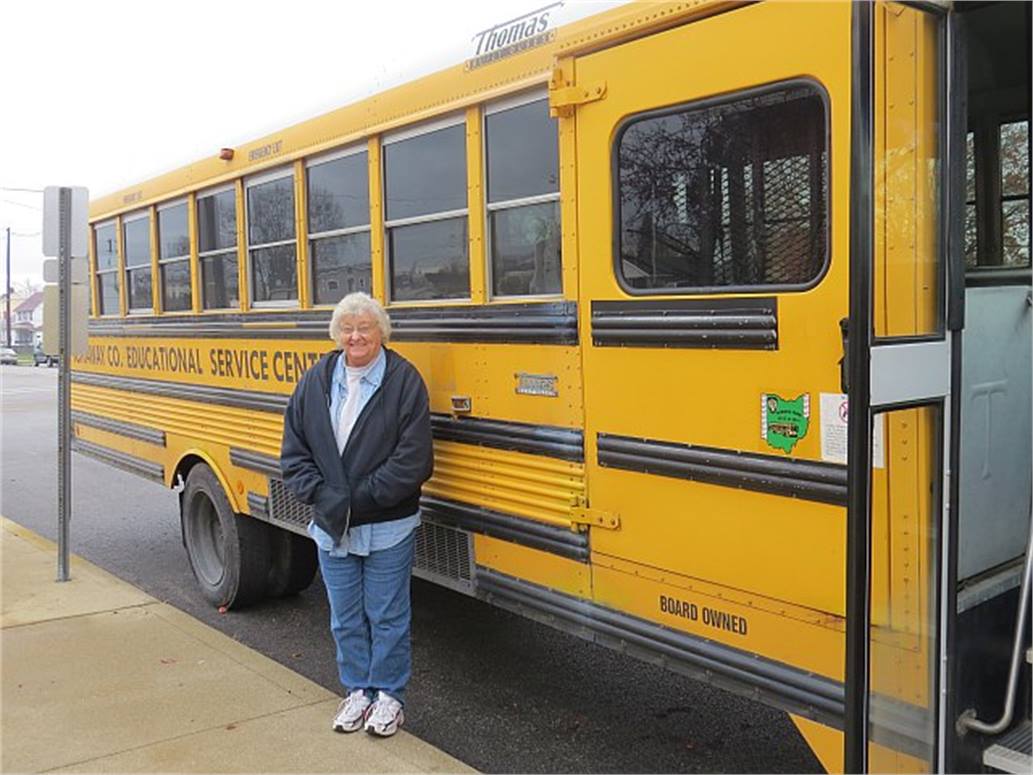
Brenda Marshell standing in front of her Special Needs Bus
Have you ever thought about what rules and regulations are involved in managing the Special Needs bus? How does the Special Needs bus help each kid? What are the procedures involved with getting them onto the bus? What kind of restraining devices do they use to keep these kids in their seats? Is your Special Needs bus up to date on the equipment that they need and are required to have to assist each kid? All these questions can be answered by the bus driver, Brenda Marshell, and the bus monitor, Dawn Scrivner, of the Special Ed bus in Rankin County. Continue reading Is Your Special Needs Bus Up to Date on IDEA Regulations?→
This spring break is something I have been patiently waiting on for some time now. Being on a college tennis team has it perks, one being on this break. I had the opportunity to travel to Orlando Florida to play tennis in a national tournament this spring break. Although being with my team and people that I look up to, I wanted nothing more than to be at home. This break has given me time to think about who I am and what I want in this life. Coming home this past Wednesday from my Orlando trip, I have had certain topics swirling through my mind. These topics consist of what I want and who I am; finally I have come to a conclusion. Sometimes real is hard. Continue reading Spring Break Reflection→
For my spring break, I spent it in St. Louis, Missouri. We had a great time! We left Monday around 3:45 am and got into St. Louis around 11:30 am. The drive however was super boring which began to give us doubts about our vacation spot but it simply didn’t let us down! Continue reading St. Louis→
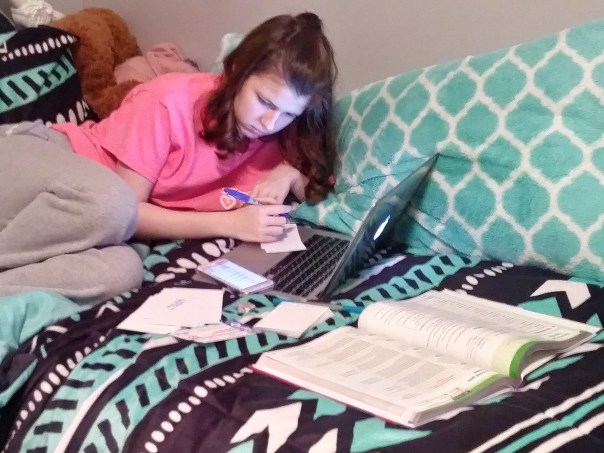
Ashley Scrivner is hard at work, completing her homework in preparation to move up to her last year of high school where she will be taking five dual credit classes.
Ashley Scrivner, a sophomore at Northwest Rankin High School in Flowood, Mississippi, plans to graduate high school a year early. She wants to group her junior year and senior year together into one. In order to accomplish this goal, she has several options that she can choose from. Continue reading Should You Make the Decision to Graduate Early?→
In January of 2019, a record-breaking winter storm tore through the Midwest inflicting major damages and taking twenty-one lives. The U.S. Postal Service suspended service in parts of several states. Wind chill temperatures were as cold as minus 66 degrees in Minnesota. In Chicago 1,000 flights arriving and departing were canceled. Moreover, the freezing temperatures barely allow someone to step outside for 5 minutes without risk of health issues or accidents.
By: Brian Kersey
The winter storm accumulated due to a fracture in the polar vortex. The polar vortex is described by climatologists as a dome of cold air that sits on the polar part of our planet. At the edge of the dome is the polar front that rotates from west to east. For reasons unknown, it started to tilt and rotate north and south. Depending on which way it’s tilted changes where the cold air is going to go. Discussing the measures taken during and after the winter storm to prepare and assist the community in insuring the safest outcome, Paul Gross, meteorologist at WDIV in Detroit, Michigan, states, “I always give the public very specific communication regarding timing and impacts of the approaching weather… during the storm, I step up my social media reporting, frequently tweeting radar images, temperatures, etc. After a winter storm, I communicate ‘what to do’ information, such as if somebody sees a downed power line, if their gutters are overflowing with ice and icicles, etc.” Scientist are not sure why the vortex is moving south toward the U.S. however, they have discovered that it is going to become common. Continue reading Midwest Buried Under Blanket of Snow→
Does the city of Jackson lack professional sports? The National Pro Fastpitch Association seems to think so with the professional softball team the Colorado Bandits to Jackson, Mississippi and changing the name to the “Jackson Bandits”.
Professional sports are no stranger to the area of Jackson as there used to be a professional hockey team from 1993 to 2003. They played weekly in the coliseum off Mississippi St. There is also a professional minor league baseball team in Pearl who is affiliated with the Atlanta Braves. The Mississippi Braves had a 67-71 record in 2018 and average 2,225 spectators a game.
It appears The Mississippi Braves game has brought a fun atmosphere and family outing but how do the citizens of Jackson feel of the matter?
“I think it would be an awesome experience to get to see girls so much older and more experienced in the game than I am to get to play the game that we all love” Brittany Chetta of Belhaven softball says. “Knowing that we all have that in common, yet we are so different. It would be such a learning experience every time I came and watched them play. It would be so cool.”
Amber Allen of the Jackson community also thinks it would be an awesome thing for the city of Jackson. “There are so many bad things in the news I think this would be something positive and a good think for kids, families or teenagers to get out and do on a weeknight or weekends. My teenage daughter who plays middle school softball is especially excited.”
Belhaven head coach Kevin Griffin is especially excited, “Man, I think it is awesome. This is going to be awesome and such a learning experience for my girls. Hopefully the two of our programs can get together and do a camp and we can learn something good from them. I think this is a good thing for our city and our program because playing softball is often watching and learning.”
The Jackson Bandits look to complete their stadium during the summer of 2019. They will begin practices in fall of 2019 and begin their season in February of 2020.
At Tulane University, Justin hugger, freshman psychology major, describes his experience in his dorm as pretty low standard for the amount he pays for tuition. “I end up not wanting to go in my dorm as much because of the quality. I’d rather study somewhere else. It’s more like i’m paying to have access to the university instead of paying for my own living space.” Katelyn Head, junior communications major, from Belhaven University said, “I like my dorm because it is cozy, but we have a ladybug infestation at night that can get a little annoying. Hannah Vanderbijl, senior international studies major, who is a resident advisor in the same dorm as Head, said, “The heating/cooling systems could be more efficient.” The same temperature problem persists with Josie Brown, sophomore nursing major, “The temperature sometimes makes it miserable to be on campus,” she said about Gillespie Commons at Belhaven University. Vanderbijl and Brown both get a lot of complaints that can sometimes be fixed, but usually it’s an infrastructure problem.
Some students are fine with the quality of their dorm because it is satisfactory to the amount of tuition is paid. Corey Barkum, freshman computer science major, at Southeastern Louisiana University said, “ I have no complaints so far, my bed is so comfortable that I often struggle leaving bed for class.” Charity Williams, sophomore social work major, of Belhaven University feels the price of her dorm is “Way overpriced, but the quality is nice.” Meanwhile, Hugger is ready to move out of the dorms because “the apartments around the campus are cheaper, better maintenance, they have personal bathrooms, and they are cleaner and bigger for better pricing.
Many students are just grateful to have a place to live while going to school all week. Commuting can make it harder to do better in school and become accustomed to the school environment. Vanderbijl said, “I personally love it [her dorm]. It’s very homey and cozy to me and central to the rest of the campus.” Fortunately, most of these students said their dorm quality doesn’t affect their school life but they would rather not live in a dorm. “Yes, the dorms aren’t great, but I wouldn’t replace the great moments I spent in my dorm” said Head. Prospective students should talk to other students about the dorms before moving in, so they could avoid any of these issues and be comfortable for the next years of their life.
Being a student athlete can be a full time job, bouncing between the weight room, the court/field, classes, and film sessions. So why aren’t student athletes paid?
College athletics are considered extra curricular activities, but the schedules of the National Collegiate Athletic Association tournaments require a lot of time. In this time students must miss school, in a school like Belhaven University, these are not excused absences. “It’s hard to balance school and tennis, especially when you get no days off because nothing is excused,” said Macey Lea of Belhaven University tennis team.
Student athletes who bring in revenue for their school or team argue that they should be paid some portion of the revenue considering they are the reason for the money, “It’s honestly not that fair considering we bring in thousands of fans, and get a scholarship in return, don’t get me wrong a scholarship is good, but it would be nice to have a portion of what we actually bring in”, said Benjamin Nola, senior on Louisiana State University’s football team.
If NCAA athletes were to be paid, would they be paid differently considering the sport? Joan Soler, senior on Belhaven University tennis team said, “oh yeah, for sure, also considering where you are, tennis isn’t that big of a sport here so a tennis player would be paid different than a football player because it’s the south”. This isn’t considered fair pay, but those who support paying college athletes say that team popularity and players generally would determine the pay.
“Most profits from college athletics do not go towards academics, instead they go to the coaches, athletic directors, and some administrators”, according to Edelman of CollegeExpress.com. Of course, college athletes shouldn’t get paid like the coaches, but they could still receive a reasonable amount considering how much the program’s revenue is. Where would the money come from? Thomas Blake, senior on Belhaven University soccer team said, “It would make most sense that the money would come from the profit that the school is making off of the games, but at a school like Belhaven who doesn’t charge to get in games it would be hard to pay athletes here. It’s also a Christian private university so it would be extremely hard to pass a rule that student athletes should get paid here”.
According to a 2013 survey done by John Dennis, 69% of the public is opposed to paying student athletes, why? John R. Thelin said in his article, “Here’s Why We Shouldn’t Pay College Athletes”, “If salaries were given, then these college student-athletes would have to pay taxes. Depending on the student-athlete’s income, those taxes could be high enough to reduce what they earn until they can barely cover tuition”. Most people that are opposed to the idea of paying student athletes say that scholarships are the best option; those same people also say that it would change the nature of college athletics. It is very difficult to become a college athlete, only 7% of high school athletes go on to be college athletes.
The debate on whether student athletes should get paid or not goes on and on, especially on the internet. There are facts and statistics on each side of the argument. Do you think college athletes should be paid?
my kicker for readers to comment would be the question at the end. This would give me feedback on other people thoughts.
“It depends,” says
Belhaven University guidance counselor, Christa Williams. “What are you
sheltering them from?”.
It’s no secret that colleges and universities bring people of many different backgrounds together. Some people come into college ready to continue an already started road to independence. However, for many, college is a young adult’s first experience with freedom. With these new freedoms, some students can struggle with mental health (depression, anxiety etc.,) and temptations to gravitate towards what might be considered to be bad things (excessive drinking, drugs, etc.). Bestcolleges.com reports that 1 in 4 college age students struggle with a mental illness brought about by their transition to college. How many of these mentally unstable students are previously-sheltered young adults?
Research is being done on Belhaven University’s Jackson campus to determine the overall positive or damaging effects being raised sheltered has on a college student. Belhaven’s very own Christa Williams explained that the answer is not going to be easy to find, because sheltering comes in many forms and different extremes. Williams says she as a counselor has seen young adults from all backgrounds struggle in college. Everyone can have mental struggles.
An online survey asked current college students to explain ways they’ve seen sheltering affect their sheltered peers. One response from an anonymous source wrote, “They have a hard time adapting to the new environment and quickly get overwhelmed. They also have a hard time breaking ties with family.” Responders to the survey were asked to grade how much more they believed a sheltered young adult would struggle in college than a person who was not sheltered the response average was 73 percent, meaning people taking the survey, most not considering themselves sheltered, believed that sheltered young adults were 73 percent more likely to struggle with their new-found freedom in college. The results from the survey indicate that there is an overall concern about sheltered young adults.
Rebekah Veldhorst, 20, sat down in an interview to discuss why many assume sheltered students struggle more than others. “I think it’s just because there’s a lot of stuff they didn’t know very much, and when they get to college, they’re away from their families so there’s a lot of influx of new information. Just they, they don’t know what to do with that, so, just people assume they go wild.” Veldhorst, a sophomore at Belhaven says she has seen sheltered students befriend “bad influences” but does not personally know someone who lost control of themselves due to sheltering.
Ashley Farris, 21, a junior, gave a strong “No” when asked if she was sheltered growing up. Farris believes the idea that sheltered young adults do struggle more when transitioning into college. “I think if you’re not prepared for the world, you don’t know what to expect from the world. You’re not going to be successful immediately. I think you’re gonna have to have a lot more time to adjust than someone who wasn’t sheltered.”
Between the interviews and survey, it appears that a sheltered young adult is at a higher risk of getting into trouble in college than a person who was not sheltered. A very strict home can produce a nervous, unprepared for the world young adult. Would you agree?
This blog is for students in the COM210 Newswriting & Reporting class at Belhaven University. Every journey begins with the first step.
“In writing…remember that the biggest stories are not written about wars, or about politics, or even murders. The biggest stories are written about the things which draw human beings closer together.” – Susan Glaspell Journalist and novelist
Also remember…”The art of writing is rewriting what you’ve rewritten.” Enjoy the journey!
Blessings,
Dr. Fridge
Good company in a journey makes the way seem shorter. — Izaak Walton








 com210news